
No contact tracker: track your breakup recovery and move on
A no contact tracker counts the days since you last contacted your ex. A good one does more: it shows you that you're getting better, especially on the days you can't feel it. Here's what's worth tracking, and how Zero Contact, a breakup tracker for iPhone, helps you track it and move on.
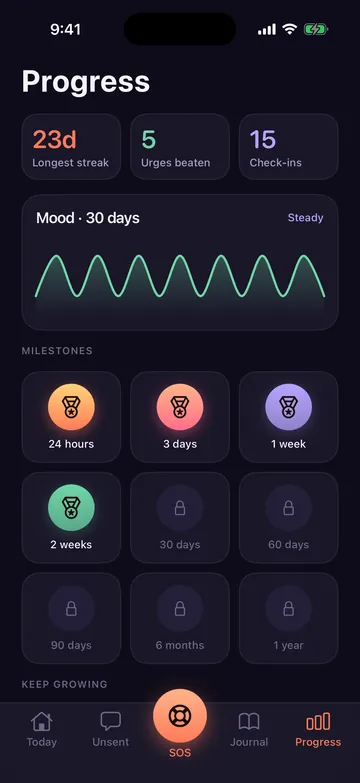
What a no contact tracker should track
- Your streak: the time since your last contact, live.
- Urges: when they come and how strong they are, so you learn your patterns.
- Mood: check-ins over weeks, because recovery isn't a straight line.
- Milestones: the moments worth marking, from 24 hours to a year.
- Slips: recorded honestly, without wiping your history.
Why tracking helps you move on
Keeping track of progress is linked to reaching goals: a large meta-analysis found that monitoring progress made people more likely to succeed, especially when that progress was recorded (Harkin et al., 2016). After a breakup, tracking also corrects a common illusion. On a bad day it feels as if nothing has changed. Your own data says otherwise: fewer urges, a steadier mood, longer gaps between the hard moments.
Track urges, not just days
Every time you open SOS, Zero Contact asks how strong the urge is, from 1 to 10. Over time you see which hours and situations are risky (late evenings, weekends, after a drink), so you can plan for them instead of being surprised. Our guide to zero contact after a breakup explains what to do in those hours.
Check-ins and mood
A daily check-in takes a few seconds: your mood, how strong the pull is and a few context tags. It stays on your device. Reminders never show their name or anything you wrote.
Moving on is the point
A tracker is a means, not the goal. The goal is to need it less. That's why Zero Contact pairs tracking with a 90-day plan, a journal and a private coach. The day you notice you haven't checked your zero contact streak in a while is progress too. For what the end of no contact looks like, read Zero Contact ending explained.
Comparing no contact trackers
If you searched for BreakFree: No Contact Tracker, that's an app from a different developer; Zero Contact isn't affiliated with it, and we won't review other apps here. Whichever no contact tracker you try, these questions are worth asking:
- Does it help in the moment of an urge, or does it only count days?
- Where is your data stored, and do you need an account?
- Can notifications ever show their name?
- What's free, and what costs money?
- Does it support low contact, for co-parents and colleagues?
Zero Contact's answers: SOS one tap away, data on your device with no account, notifications that never show their name, a free tier (see Zero Contact free) and a low contact mode.
Frequently asked questions
Is there a free no contact tracker?
Yes. Zero Contact's streak, check-ins, SOS and Progress screen are free, with no account. See what's free in Zero Contact.
What is a breakup tracker?
An app that tracks your recovery after a breakup: usually your no contact streak, plus things like mood, urges and milestones. Zero Contact is a breakup tracker built around no contact.
Does Zero Contact work without internet?
Yes. Your streak, check-ins and journal run on your device, so the tracker keeps counting offline.

From tracking the days to moving on
Zero Contact tracks your streak, urges, mood and milestones, and helps in the moments in between with SOS, a private coach and a 90-day plan. Free to start.

Sources
- Harkin, B., Webb, T. L., Chang, B. P. I., Prestwich, A., Conner, M., Kellar, I., Benn, Y., & Sheeran, P. (2016). Does monitoring goal progress promote goal attainment? A meta-analysis of the experimental evidence. Psychological Bulletin, 142(2), 198–229. doi.org/10.1037/bul0000025
Zero Contact is a self-help tool, not therapy or medical care. If you are in danger or thinking about hurting yourself, contact your local emergency number or find a helpline at findahelpline.com.